SEO is not only about improving search rankings or increasing website traffic. Businesses also need to understand whether their SEO efforts are actually contributing to meaningful results, such as leads, conversions, revenue, and overall business growth. This is where SEO performance tracking software becomes valuable.
With the right tools, businesses can monitor keyword rankings, organic traffic, backlinks, technical issues, conversions, and other important SEO metrics in one place. More importantly, these insights can help businesses understand which SEO activities are delivering results and where improvements are needed.
This guide looks at what SEO performance tracking software is, why tracking matters, the best platforms available, which metrics to monitor, how to measure SEO ROI, and how to choose the right tool for your business.
What Is SEO Performance Tracking Software?
SEO performance tracking software refers to platforms that help businesses monitor and analyse the results of their search engine optimization efforts.
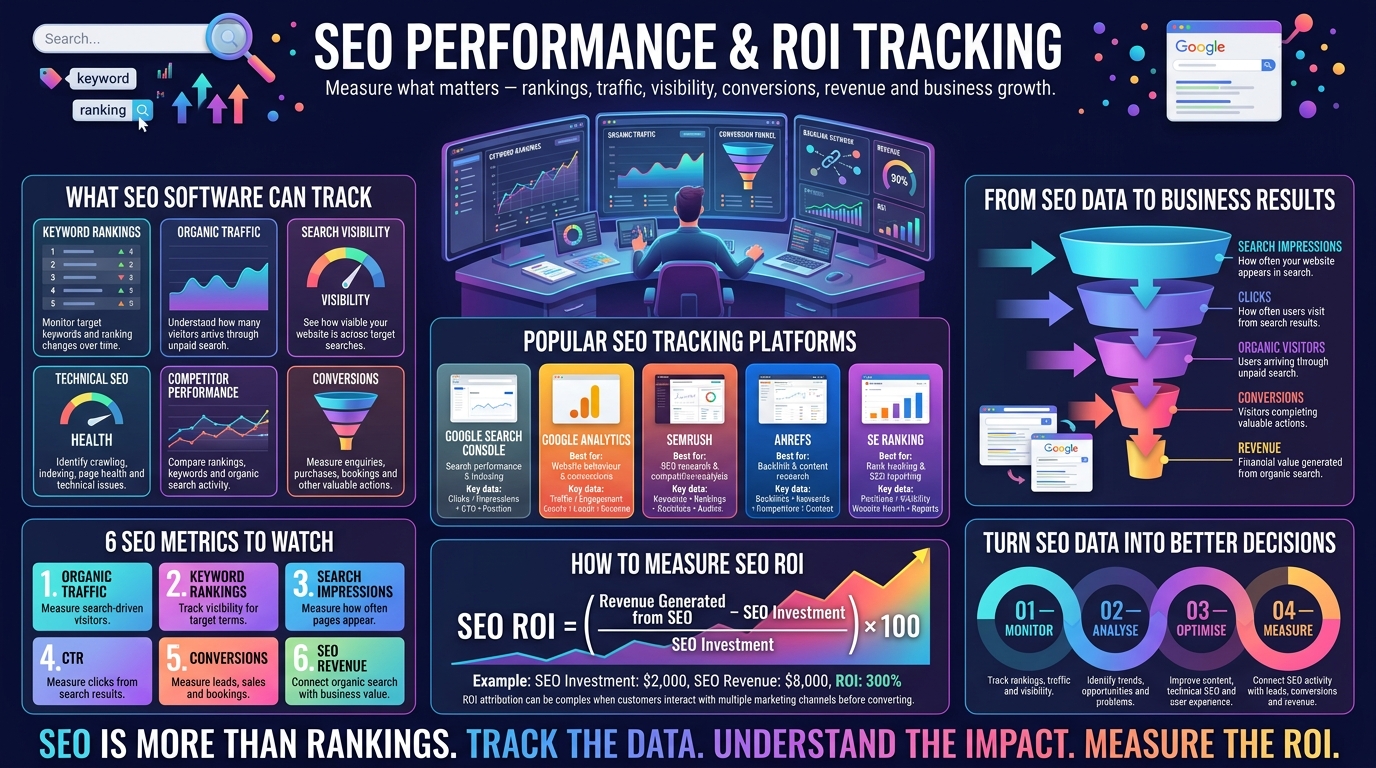
Depending on the platform, these tools can provide data such as:
-
Keyword rankings
-
Organic search traffic
-
Search visibility
-
Backlink performance
-
Website health
-
Click-through rates
-
Conversions and leads
-
Competitor performance
-
SEO trends over time
Instead of relying on assumptions, businesses can use this data to make more informed decisions about their SEO strategy.
SEO tracking software also helps businesses save time. Instead of manually checking rankings, crawling pages, and reviewing analytics data, businesses can use a single platform to monitor performance and generate reports. This makes it easier to identify trends, spot problems early, and measure progress over time.
Without tracking, SEO becomes a guessing game. Businesses may not know whether their efforts are producing results or whether they are investing in activities that do not contribute to business growth. Tracking software provides the data needed to make better decisions.
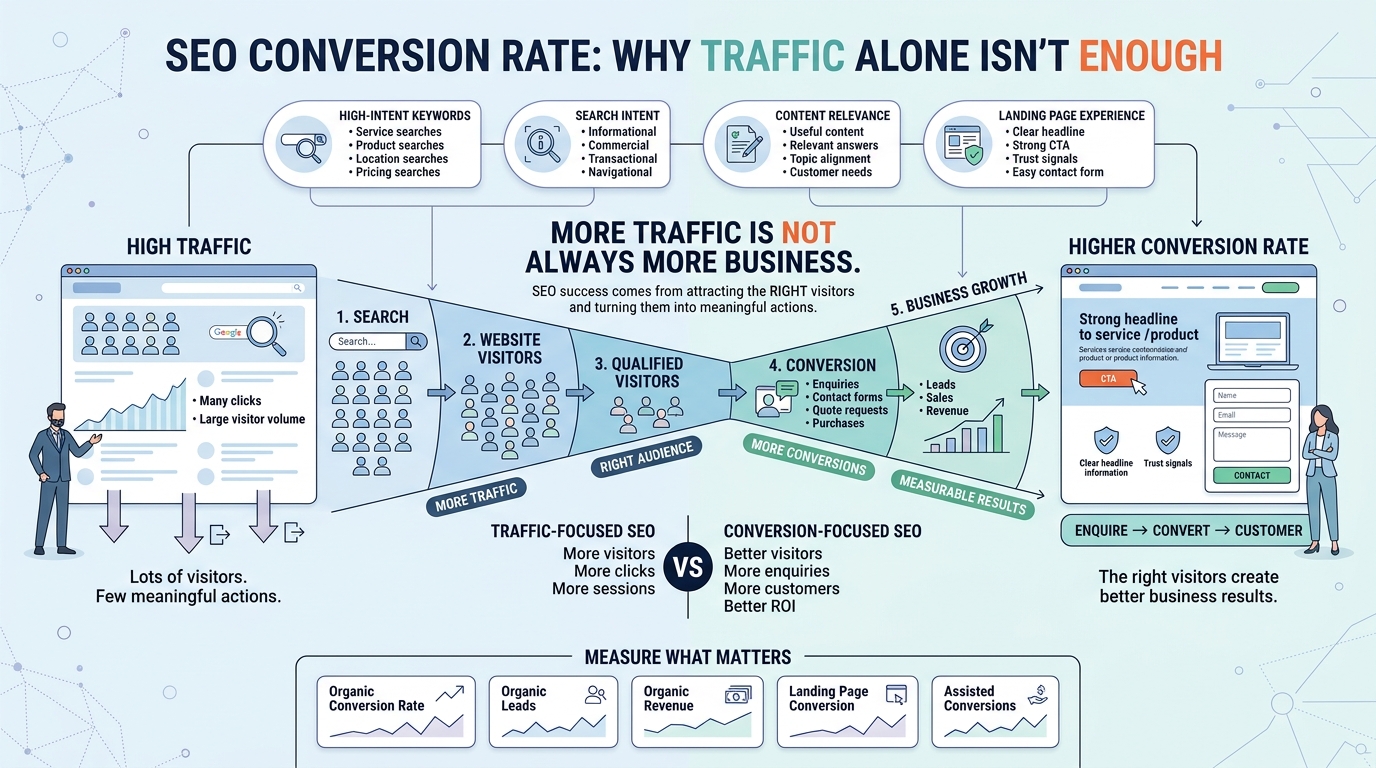
It is also important to understand that SEO tracking software is not just about rankings. Rankings alone do not tell the full story. A website can rank well for many keywords but still generate very few leads if those keywords do not match the business’s services or if the landing pages do not convert visitors into customers. This is why tracking software should be used to measure both visibility and business outcomes.
Why Is SEO Tracking Important for Businesses?
SEO can take time to produce measurable results, which makes consistent tracking important. Without monitoring performance, businesses may not know whether their strategy is working or which areas require attention.
Tracking SEO performance can help businesses:
-
Identify keywords that are gaining or losing rankings
-
Understand where organic traffic comes from
-
Discover technical SEO problems
-
Measure the performance of individual pages
-
Identify new content opportunities
-
Monitor competitors
-
Connect SEO activity with leads and conversions
Regular measurement also makes it easier to demonstrate the value of SEO to business owners and decision-makers.
Without tracking, businesses may continue investing in SEO activities that are not producing results, while missing opportunities that could have a bigger impact. Tracking turns SEO from a guessing game into a data-driven process.
Tracking also helps businesses respond faster to changes. If rankings drop or traffic declines, tracking tools can help identify the cause quickly whether it is a technical issue, a competitor outranking your content, or a change in search intent.
Another important reason to track SEO performance is accountability. When SEO is measured properly, it becomes easier to justify the investment and to identify which activities are producing the best return. This helps businesses allocate resources more effectively instead of spreading budget across activities that may not be working.
Best Software Platforms for Tracking SEO Performance and ROI
Different SEO platforms provide different features, so the right choice depends on the business, website size, goals, and reporting requirements.
Google Search Console
Google Search Console is one of the most useful platforms for understanding how a website performs in Google Search.
It provides data about:
-
Search queries
-
Impressions
-
Clicks
-
Average search position
-
Click-through rate
-
Indexing issues
-
Page performance
Because the data comes directly from Google’s search environment, Search Console can be particularly useful for identifying how users discover a website and which search queries generate visibility.
Search Console is free to use and is usually the first tool businesses should set up. It helps identify indexing problems, mobile usability issues, and page experience signals. It also allows businesses to submit sitemaps and monitor how Google crawls the website.
For businesses that want to understand how their website appears in Google Search, Search Console is essential. It provides the most accurate data available on how Google sees your website.
One of the most useful features of Search Console is the ability to see which queries are driving impressions and clicks. This helps businesses identify opportunities to improve content, adjust page titles and meta descriptions, and target new keywords.
Google Analytics
Google Analytics helps businesses understand what happens after visitors arrive on a website.
While it is not an SEO tool by itself, it can provide valuable information for measuring the business impact of organic traffic.
Businesses can use it to analyse:
-
Organic traffic
-
User engagement
-
Landing page performance
-
Events
-
Leads
-
Conversions
-
Revenue
When combined with Search Console and proper conversion tracking, Google Analytics can help connect search visibility with actual website outcomes.
Google Analytics also helps businesses understand which landing pages perform best, which traffic sources convert, and how users behave on the website. This makes it easier to identify pages that need improvement.
For SEO reporting, Google Analytics is often used to measure conversions and revenue from organic search, making it a key tool for measuring SEO ROI. Without this data, it is difficult to know whether SEO is actually contributing to business growth.
Semrush
Semrush provides a broad range of SEO and digital marketing features for businesses that need more advanced analysis.
Its SEO capabilities include:
-
Keyword tracking
-
Competitor research
-
Backlink analysis
-
Site audits
-
Keyword research
-
Organic traffic analysis
-
Position tracking
The platform can be useful for businesses that want to monitor their own performance while also understanding what competitors are doing in search.
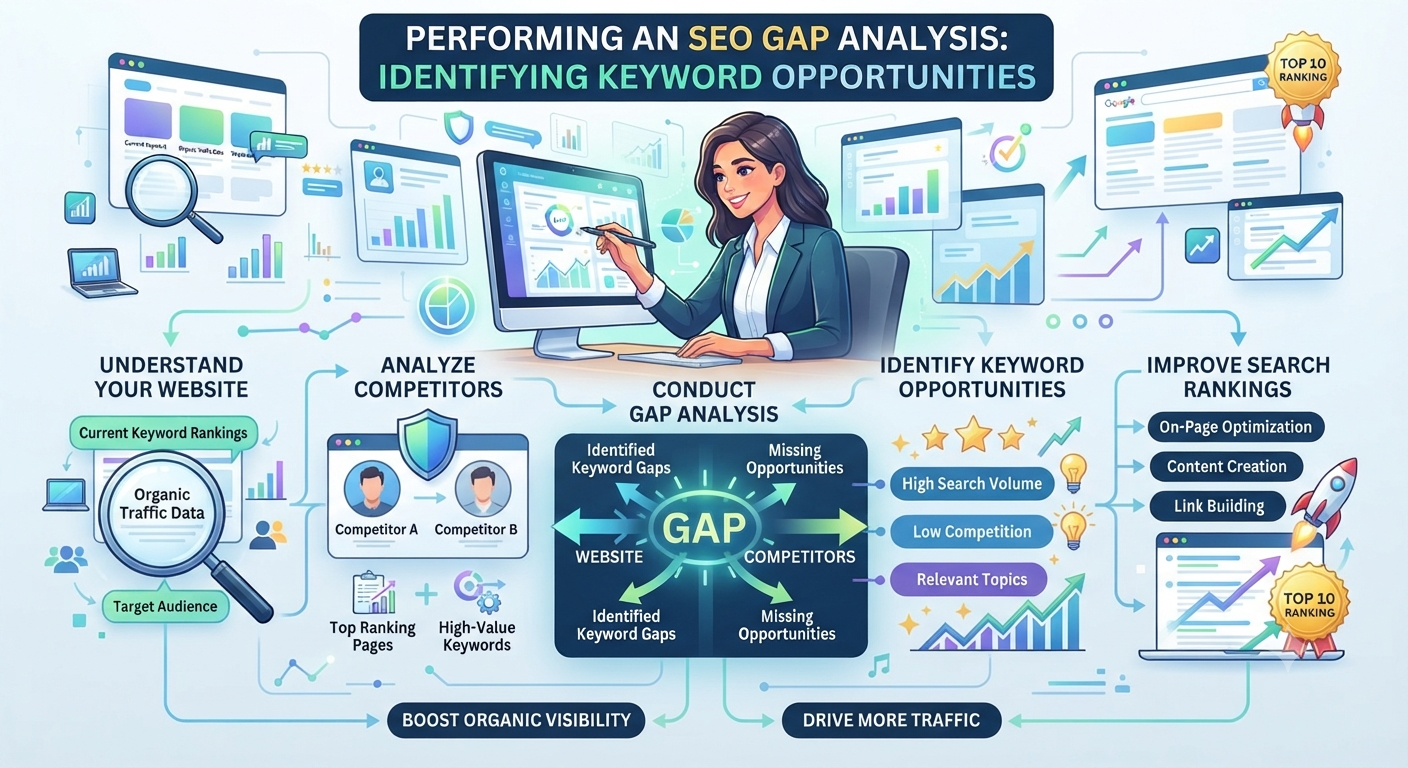
Semrush is particularly useful for competitive analysis. Businesses can compare their keyword rankings, backlink profiles, and organic traffic with competitors to identify opportunities and gaps.
It also provides reporting features that can be useful for agencies and marketing teams that need to present SEO performance regularly. Reports can be customised and automated, making it easier to share insights with clients or stakeholders.
Ahrefs
Ahrefs is widely used for backlink analysis, keyword research and competitive SEO research.
Its features can help businesses:
-
Track keyword rankings
-
Analyse backlinks
-
Research keywords
-
Review competing websites
-
Identify content opportunities
-
Monitor organic search performance
This makes it useful for businesses that place a strong focus on content strategy and link-building performance.
Ahrefs is known for its backlink data and its ability to identify content gaps. Businesses can use it to find keywords their competitors rank for but they do not, and to discover opportunities for new content.
It also provides site audit features that help identify technical SEO issues, making it useful for both content and technical SEO teams.
One of the most valuable features of Ahrefs is the ability to analyse which pages on a competitor’s website are attracting the most backlinks and organic traffic. This can reveal content topics and formats that are working well and could be replicated or improved.
SE Ranking
SE Ranking provides SEO monitoring and reporting features designed for businesses, agencies and marketing teams.
Depending on the plan and features used, businesses can monitor:
-
Keyword positions
-
Website health
-
Backlinks
-
Competitor rankings
-
Search visibility
-
SEO reports
Its reporting capabilities can also make it useful for teams that need to present SEO performance regularly to clients or internal stakeholders.
SE Ranking is often used by agencies because it offers a balance between features and affordability. It provides rank tracking, site audits, backlink monitoring, and competitor analysis in a single platform.
For businesses that need regular reporting without the cost of enterprise-level tools, SE Ranking is a practical option. It is also relatively easy to use, making it suitable for teams that are new to SEO tracking.
Which SEO Metrics Should You Track?
Having an SEO platform is only useful when businesses know which metrics actually matter.
Some important metrics include:
Organic Traffic
Shows how many visitors reach the website through unpaid search results. Organic traffic is one of the most basic indicators of SEO performance, but it should be evaluated alongside other metrics.
Keyword Rankings
Shows how target keywords perform in search results over time. Tracking rankings helps businesses understand which keywords are gaining or losing visibility.
Search Impressions
Indicates how frequently a website appears in search results. Impressions show how often a page is seen, even if users do not click.
Click-Through Rate
Helps measure how often users click on a website after seeing it in search results. A low click-through rate may indicate that page titles or meta descriptions need improvement.
Conversions
Shows whether organic visitors are completing valuable actions such as enquiries, form submissions, purchases, or bookings. Conversions are a more meaningful measure of SEO success than traffic alone.
SEO Revenue and ROI
Helps businesses understand whether organic search is generating measurable financial value. Revenue tracking connects SEO to business outcomes.
Tracking these metrics regularly helps businesses understand which parts of their SEO strategy are working and which need improvement.
It is also useful to track metrics by page and by keyword, not just at the website level. This helps identify which specific pages and keywords are performing well and which need attention.
How to Measure SEO ROI
Traffic and rankings are useful indicators, but they do not always show the complete business impact of SEO.
A simple way to think about SEO ROI is:
SEO ROI = (Revenue Generated from SEO − SEO Investment) ÷ SEO Investment × 100
For example, if a business invests in SEO and organic search generates measurable revenue or qualified leads, that information can be compared against the cost of the SEO campaign.
However, attribution can be more complicated for businesses with longer customer journeys. A visitor may discover a company through organic search but return later through another channel before converting.
For this reason, SEO ROI should be evaluated alongside other metrics rather than relying on a single number. Assisted conversions, multi-touch attribution, and customer lifetime value can all provide a more accurate picture of SEO’s impact.
It is also important to define what counts as a conversion for your business. For some businesses, a conversion is a purchase. For others, it is a form submission, a phone call, or a booked appointment. Without clear conversion definitions, SEO ROI becomes difficult to measure accurately.
How to Choose the Right SEO Tracking Platform
The best platform depends on what your business actually needs to measure.
Consider the following factors before choosing a tool:
Website Size
Larger websites may require more advanced crawling and reporting capabilities. Small websites can often work with simpler tools.
SEO Goals
Keyword tracking, technical SEO, content research, backlinks and ROI measurement may require different tools. Choose based on what you need most.
Reporting
Agencies and larger teams may need automated and custom reports. Businesses that report to clients or stakeholders should prioritise platforms with strong reporting features.
Competitor Analysis
Some platforms provide deeper competitive research than others. If competitor tracking is important, choose a platform with strong competitive features.
Budget
Pricing can vary significantly depending on features, users and tracking limits. Some platforms offer free plans, while others require monthly subscriptions.
Integration
Consider whether the platform works well with analytics, advertising and other marketing systems. Integration makes it easier to connect SEO data with other business metrics.
Instead of choosing a platform based only on the number of features, focus on whether it provides the data needed to support your actual SEO objectives. The best platform is not always the most expensive one — it is the one that gives you the insights you will actually use.
Turning SEO Data Into Better Decisions
SEO tracking should not stop at collecting numbers. The real value comes from using the information to improve your strategy.
For example, a drop in rankings may indicate a technical issue, stronger competition, outdated content, or changes in search behaviour. Similarly, a page receiving significant organic traffic but producing few conversions may need improvements to its content, user experience, or call-to-action.
By reviewing SEO data regularly, businesses can identify these patterns and make strategic changes based on evidence rather than guesswork.
Regular reviews, monthly or quarterly help businesses stay on top of changes and make adjustments before small issues become bigger problems. SEO tracking is most effective when it becomes part of an ongoing process, not a one-time task.
It also helps to review SEO data alongside other business metrics, such as sales, enquiries, and customer acquisition costs. This provides a more complete picture of how SEO contributes to business growth.
Conclusion
Choosing the right SEO performance tracking software can help businesses move beyond simply watching rankings and traffic. By combining search data, website analytics, keyword performance, technical insights, conversions, and revenue measurements, businesses can gain a clearer understanding of how SEO contributes to their overall goals.
The most useful platform is not necessarily the one with the most features, but the one that provides relevant data, supports consistent measurement, and helps turn SEO insights into better business decisions. A simple combination of Google Search Console and Google Analytics can already provide valuable insights, while more advanced platforms like Semrush, Ahrefs, and SE Ranking offer deeper analysis for businesses that need it.
The key is to track consistently, measure what matters, and use the data to improve. SEO tracking is not about collecting numbers for the sake of it — it is about understanding what is working, what is not, and where to focus next.
FAQs
1. What is SEO performance tracking software?
SEO performance tracking software refers to platforms that help businesses monitor and analyse the results of their SEO efforts. These tools provide data on keyword rankings, organic traffic, backlinks, website health, conversions, and other important SEO metrics.
2. Why is SEO tracking important for businesses?
SEO tracking is important because it helps businesses understand whether their SEO strategy is working. Without tracking, businesses may not know which activities are producing results, which keywords are gaining or losing rankings, or whether organic search is contributing to leads and revenue.
3. Which SEO tracking platform is best?
There is no single best platform. The right choice depends on your website size, SEO goals, reporting needs, budget, and whether you need competitor analysis. Google Search Console and Google Analytics are essential starting points, while Semrush, Ahrefs, and SE Ranking offer more advanced features.
4. How do I measure SEO ROI?
SEO ROI can be measured using the formula: (Revenue Generated from SEO − SEO Investment) ÷ SEO Investment × 100. However, attribution can be complex for longer customer journeys, so SEO ROI should be evaluated alongside other metrics such as assisted conversions and customer lifetime value.
5. What metrics should I track for SEO?
Important SEO metrics include organic traffic, keyword rankings, search impressions, click-through rate, conversions, and SEO revenue. Tracking these metrics regularly helps businesses understand which parts of their SEO strategy are working.