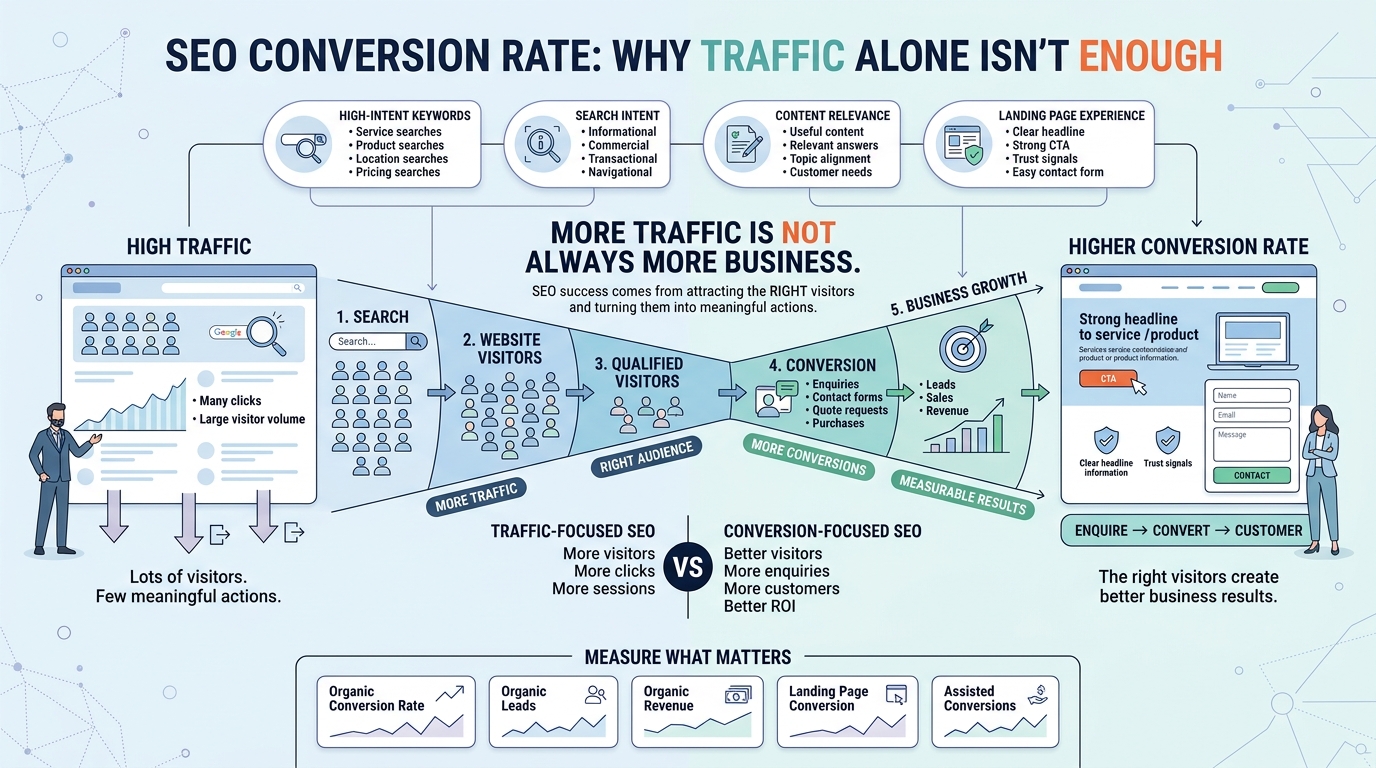
SEO conversion rate is an important measure of whether organic search traffic is contributing to meaningful business results. While increasing website traffic, keyword rankings, and search visibility can create more opportunities, attracting more visitors does not automatically mean generating more leads, sales, or customers.
However, website traffic alone does not tell the full story. A website can attract thousands of organic visitors while generating very few leads, enquiries, or sales if those visitors are not relevant to the business or do not have strong purchasing intent.
Focusing on SEO conversion rate allows businesses to look beyond traffic volume and understand how effectively organic search visitors contribute to meaningful business outcomes. By targeting high-intent keywords, matching content with search intent, optimizing landing pages, and measuring conversions, businesses can turn organic search visibility into measurable growth.
Understanding SEO Traffic and Conversion Rate
To build a conversion-focused SEO strategy, it is important to understand the difference between attracting organic visitors and converting those visitors into customers.
Organic traffic refers to visitors who arrive at a website through unpaid search engine results. SEO conversion rate, on the other hand, measures the percentage of those visitors who complete a desired action after arriving on the website.
Organic SEO traffic can be measured through:
- Organic sessions
- Organic users
- Keyword rankings
- Search impressions
- Organic click-through rate
- Landing page traffic
SEO conversions can include:
- Contact form submissions
- Product purchases
- Quote requests
- Phone enquiries
- Appointment bookings
- Account registrations
Traffic measures how many people arrive, while conversion rate helps determine how valuable those visitors are to the business.
Why Website Traffic Alone Does Not Guarantee Business Growth
High website traffic may appear to indicate successful SEO performance, but large visitor numbers do not necessarily translate into more customers.
A website can receive substantial organic traffic while experiencing:
- Low lead generation
- Few product purchases
- Poor engagement
- High bounce rates
- Low-quality visitors
- Weak conversion performance
This often happens when businesses focus primarily on high-volume keywords without considering whether those keywords attract people who are actually interested in their products or services.
For example, an informational article may generate thousands of monthly visitors because it answers a popular question. However, a service page receiving a smaller number of visitors may generate significantly more enquiries because those visitors have stronger commercial intent.
The value of SEO therefore depends not only on how much traffic a website receives, but also on the quality and intent of that traffic.
Why SEO Conversion Rate Matters for Business Results
SEO should ultimately contribute to measurable business objectives rather than simply increasing visitor numbers.
A strong SEO conversion rate can indicate:
- Better keyword targeting
- Higher-quality organic traffic
- Stronger search intent alignment
- More effective landing pages
- Better user experience
- Higher return on SEO investment
Businesses that track conversions can identify which organic search activities are actually contributing to leads, sales, and revenue.
Instead of asking only, “How much traffic did SEO generate?”, businesses should also ask, “How much business did that traffic generate?”
Targeting High-Intent Keywords
One of the most effective ways to improve SEO conversion rates is to focus on keywords that indicate stronger commercial or transactional intent.
High-intent searches may include:
- Service-related keywords
- Product-specific keywords
- Location-based keywords
- Pricing-related searches
- Comparison keywords
These searches often indicate that users are actively evaluating a solution or preparing to take action.
Targeting high-intent keywords allows businesses to attract visitors who are more closely aligned with their products and services instead of focusing exclusively on keywords with the highest search volume.
Matching Content With Search Intent
Search intent plays an important role in determining whether organic visitors are likely to engage with a website.
Different searches represent different user needs, including:
- Informational intent
- Commercial intent
- Transactional intent
- Navigational intent
Informational searches are generally focused on learning, while commercial searches involve researching potential solutions. Transactional searches indicate stronger action or purchasing intent, while navigational searches are used to find a specific website or business.
Aligning content with the correct search intent helps businesses provide visitors with the information they actually need.
When content matches expectations, visitors are more likely to remain on the website, explore relevant pages, and move toward conversion.
Optimizing Landing Pages for Organic Conversions
Driving qualified visitors to a website is only the first stage of the SEO process. Once visitors arrive, landing pages need to provide a clear and simple path toward the next action.
Effective SEO landing pages should include:
- Clear and relevant headlines
- Strong calls to action
- Helpful and focused content
- Trust signals
- Easy-to-use contact forms
- Mobile-friendly layouts
- Simple website navigation
A landing page that ranks well but provides a poor user experience may generate traffic without generating meaningful results.
Improving landing pages can therefore increase the value of existing organic traffic without requiring businesses to continuously increase visitor numbers.
Using Internal Linking to Support Conversions
Internal linking is another important part of a conversion-focused SEO strategy.
Strategic internal links help users discover relevant information while also helping search engines understand the relationship between different pages on a website.
Internal linking can be used to:
- Guide visitors toward service pages
- Connect blog content with commercial pages
- Support important landing pages
- Improve website navigation
- Distribute authority between relevant pages
For example, an informational blog article can link naturally to a related service page. This creates a pathway that allows visitors to move from researching a problem toward considering a solution.
Identifying High-Converting SEO Pages
Not every page on a website contributes equally to business performance.
SEO analysis can reveal which pages generate the strongest results, including:
- Organic leads
- High conversion rates
- Commercial search traffic
- Product enquiries
- Assisted conversions
Identifying high-performing pages allows businesses to understand which content, keywords, and landing page experiences are producing the most value.
These insights can then be applied to other pages that receive organic traffic but have weaker conversion performance.
Reducing Low-Quality Organic Traffic
Increasing traffic without considering relevance can result in large numbers of visitors who have little interest in the business.
Businesses can improve organic traffic quality by:
- Refining keyword targeting
- Removing irrelevant search terms
- Improving content relevance
- Focusing on specific customer needs
- Matching landing pages with search intent
The objective should not always be to attract the largest possible audience.
In many cases, attracting fewer highly relevant visitors can produce more enquiries, sales, and revenue than attracting large volumes of unqualified traffic.
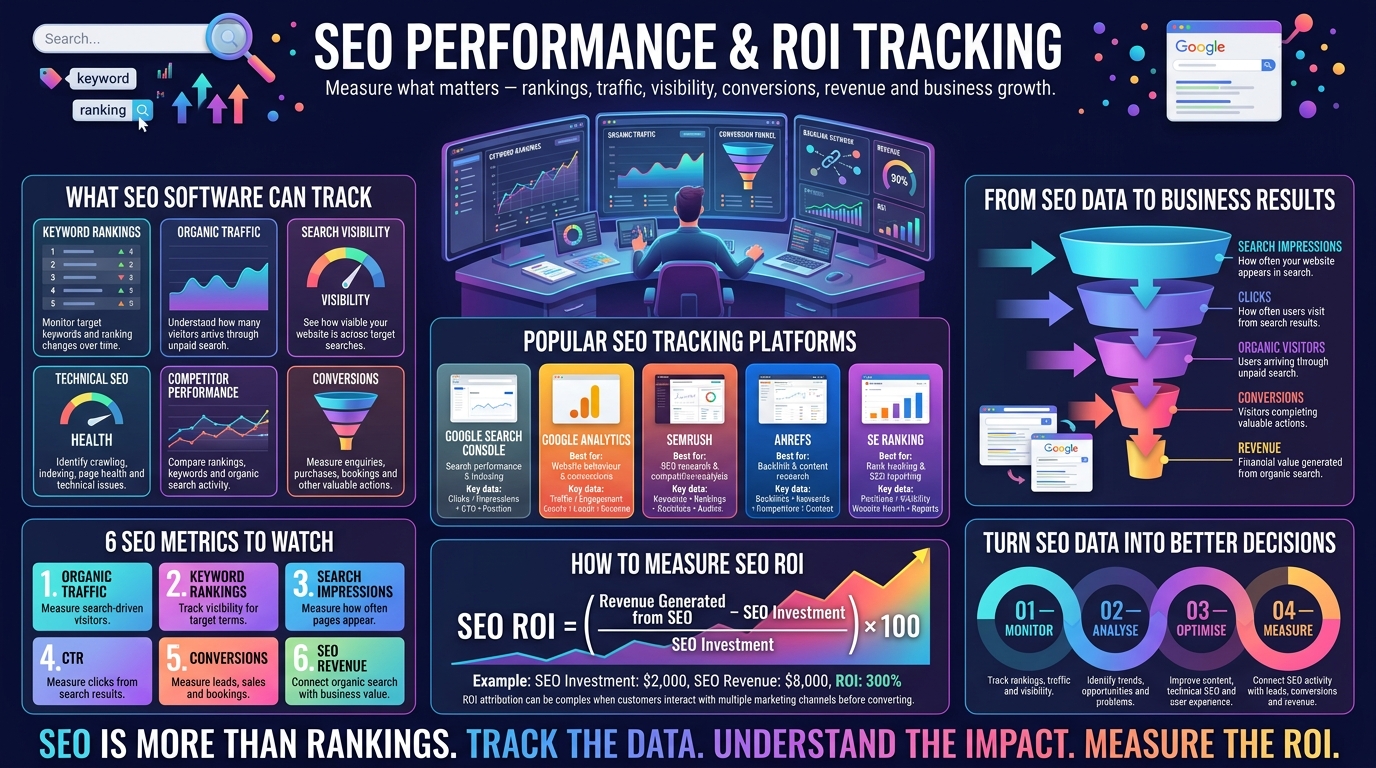
Measuring SEO Performance Beyond Rankings
Keyword rankings and organic traffic remain important SEO metrics, but they should not be used as the only indicators of success.
A more complete SEO measurement framework should include:
- Organic conversion rate
- Organic leads
- Organic revenue
- Conversion rate by landing page
- Conversion rate by keyword
- Organic customer acquisition cost
- Assisted conversions
Tracking these metrics allows businesses to understand how organic search contributes to the overall customer journey.
It also helps SEO teams identify which areas deserve more investment and which activities may need improvement.
Building a Conversion-Focused SEO Strategy
A conversion-focused SEO strategy connects search visibility with actual business objectives.
Businesses can strengthen their SEO strategy by:
- Targeting high-intent keywords
- Creating content around search intent
- Optimizing conversion-focused landing pages
- Improving internal linking
- Strengthening calls to action
- Tracking organic conversions
- Improving user experience
This approach allows SEO to become more than a traffic-generation channel.
Instead, organic search becomes a measurable source of qualified leads, customers, and revenue.
Balancing Traffic Growth and Conversion Quality
Businesses should not completely ignore traffic growth. Increasing relevant organic traffic can create more opportunities for conversions.
However, traffic growth should happen alongside improvements in visitor quality and conversion performance.
A balanced SEO strategy should focus on:
- Increasing qualified organic traffic
- Improving search intent alignment
- Optimizing important landing pages
- Reducing irrelevant traffic
- Strengthening internal linking
- Improving user experience
The objective is to create sustainable growth where increased visibility also produces meaningful business outcomes.
Long-Term Advantages of Conversion-Focused SEO
Treating SEO as a conversion-focused marketing channel can provide lasting advantages for businesses.
These include:
- More qualified organic traffic
- Higher lead generation
- Increased online sales
- Better marketing ROI
- Lower customer acquisition costs
- Stronger landing page performance
- Better understanding of customer intent
- More measurable SEO results
By focusing on conversions rather than traffic alone, businesses can make better decisions about content creation, keyword targeting, website optimization, and SEO investment.
Conclusion
SEO and organic traffic remain important components of digital marketing, but traffic volume alone does not determine whether an SEO strategy is successful. A website can attract thousands of visitors and still produce limited business results if those visitors are not relevant or ready to take action.
A conversion-focused SEO strategy looks beyond rankings and traffic to understand how organic visitors contribute to leads, sales, and revenue. By targeting high-intent keywords, matching content with search intent, optimizing landing pages, improving internal linking, and tracking conversion performance, businesses can extract greater value from their organic search visibility.
SEO success is not simply about getting more people to visit a website. It is about attracting the right people, providing them with the information they need, and giving them a clear reason to take action.
Businesses that combine strong organic visibility with conversion-focused optimization are better positioned to turn search traffic into measurable business growth.
FAQs
1. What is SEO conversion rate?
SEO conversion rate is the percentage of website visitors who arrive through organic search and complete a desired action, such as submitting a contact form, making a purchase, requesting a quotation, booking an appointment, or contacting a business.
2. Why is SEO conversion rate more important than traffic alone?
Traffic measures the number of visitors a website receives, while conversion rate shows how effectively those visitors contribute to business goals. A website with fewer but highly relevant visitors can generate more leads and sales than a website with significantly higher but low-quality traffic.
3. Can a website have high organic traffic but low conversions?
Yes. High traffic can result in low conversions when a website targets irrelevant keywords, attracts users with low purchasing intent, has poor landing page experiences, or fails to match content with search intent.
4. How can businesses improve their SEO conversion rate?
Businesses can improve SEO conversion rates by targeting high-intent keywords, creating content that matches search intent, optimizing landing pages, strengthening calls to action, improving internal linking, and monitoring conversion performance.
5. Should businesses focus on SEO traffic or conversions?
Businesses should focus on both, but traffic should be relevant and connected to business objectives. Increasing qualified organic traffic while improving conversion performance creates a stronger foundation for long-term SEO growth.