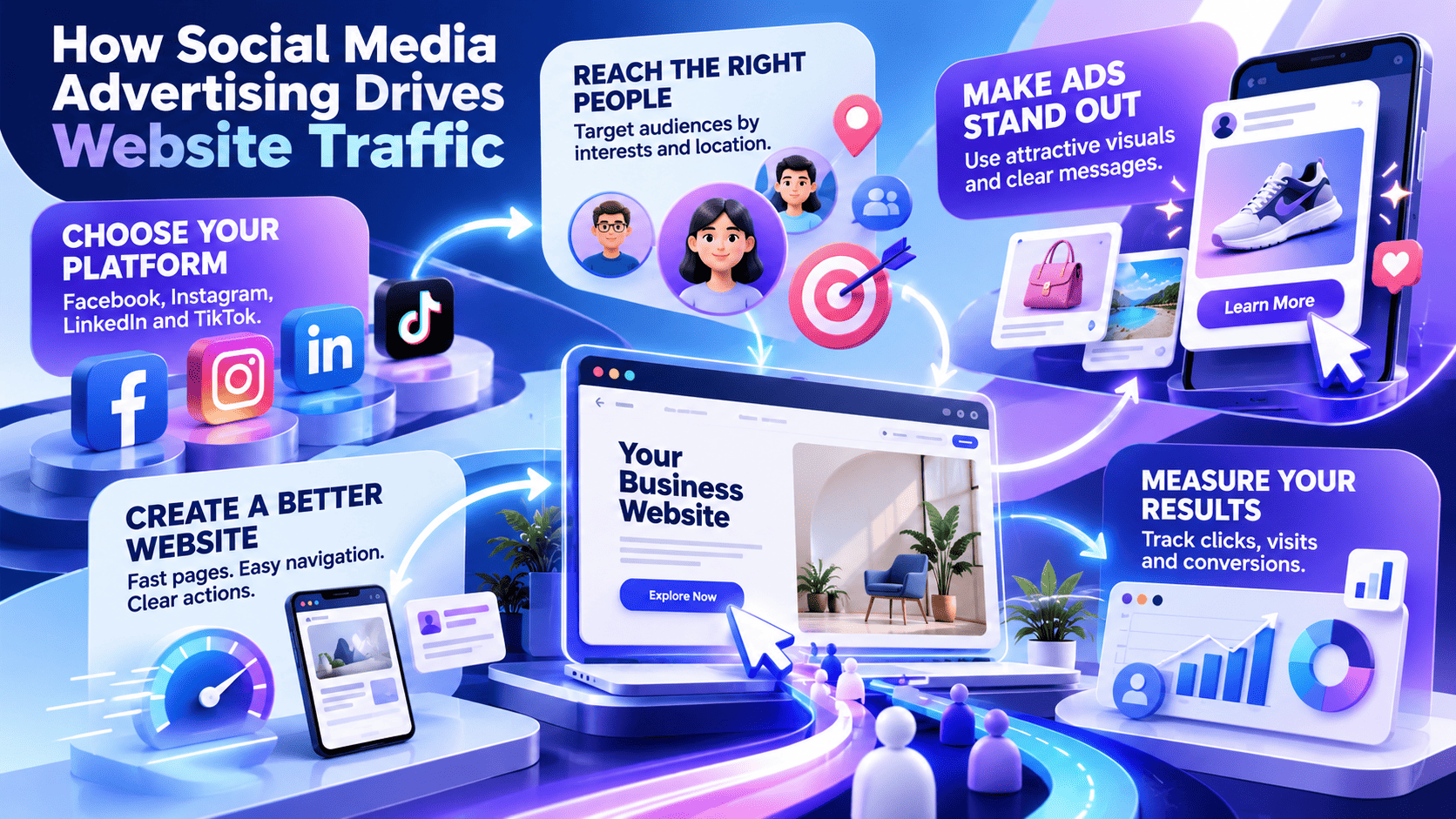
Social media advertising helps businesses drive website traffic, reach potential customers, and improve online visibility. Platforms such as Facebook, Instagram, LinkedIn, and TikTok allow businesses to promote their products, services, and content to relevant audiences.
However, successful advertising requires more than generating clicks. Businesses need engaging advertisements, effective audience targeting, and well-optimised landing pages to encourage visitors to take action.
What Is Social Media Advertising?
Social media advertising involves paying to display promotional content on social media platforms. Businesses can use paid campaigns to increase brand awareness, promote products, generate enquiries, and direct users to specific website pages.
Unlike organic social media posts, paid advertisements allow businesses to use available targeting options to reach selected audiences. This can help businesses introduce their offerings to people who may be interested in their products or services.
Popular social media advertising platforms include:
- Facebook Ads: Help businesses reach different audience groups and promote products, services, and website content.
- Instagram Ads: Support visual campaigns through images, videos, Stories, and other available advertising placements.
- LinkedIn Ads: Help businesses reach professionals, decision-makers, and organisations for B2B marketing.
- TikTok Ads: Allow businesses to promote their offerings through creative short-form video advertisements.
The right platform depends on the target audience, campaign objectives, available budget, and type of content being promoted.
Benefits of Social Media Advertising for Website Traffic
Social media advertising gives businesses another way to attract website visitors instead of relying entirely on organic search or existing audiences.
Paid campaigns can introduce a business to new users, promote valuable resources, and encourage interested people to visit relevant website pages.
Some important benefits include:
- Reaching new audiences: Advertisements can introduce your business to potential customers who may not have discovered your website before.
- Increasing brand awareness: Repeated exposure to relevant campaigns can help people become more familiar with your products and services.
- Promoting website content: Businesses can share blog articles, service pages, guides, and other useful resources.
- Generating enquiries: Campaigns can direct potential customers to contact forms, quotation pages, and service information.
- Supporting product sales: E-commerce businesses can promote products and direct interested users to relevant product pages.
When advertisements reach the right audience, businesses have a better opportunity to attract visitors who are genuinely interested in their offerings.
Choosing the Right Social Media Advertising Platform
Not every social media platform is suitable for every business. Choosing the right platform helps businesses focus their advertising efforts on audiences who are more likely to engage with their campaigns.
Before selecting a platform, businesses should consider where their potential customers spend time and what type of content is most relevant to them.
Important factors include:
- Target audience: Identify the people you want to reach and the platforms they commonly use.
- Campaign objectives: Decide whether you want to increase website visits, generate leads, promote products, or encourage purchases.
- Content format: Consider whether images, videos, carousels, or professional content are most suitable for your campaign.
- Advertising budget: Compare the available campaign options and choose a budget that supports your marketing goals.
For example, a retail business may use Facebook and Instagram advertising to promote products, while a company offering professional services may consider LinkedIn for reaching business decision-makers.
Businesses should also test different platforms and evaluate their results before committing a larger budget to a particular channel.
How to Create Effective Social Media Ads
An effective advertisement needs to capture attention and communicate value quickly. If the message is unclear or the content is irrelevant, users may scroll past without visiting the website.
Businesses should create advertisements that explain what they offer and why the audience should learn more.
Important elements include:
- Clear headlines: Explain the main benefit of your product, service, or content.
- Attractive visuals: Use relevant images and videos that capture attention and support your message.
- Customer-focused copy: Explain how your offering addresses a customer need instead of focusing only on business features.
- Relevant offers: Promote useful guides, service information, product demonstrations, or special offers where appropriate.
- Consistent messaging: Make sure the advertisement matches the content users see after clicking through to your website.
For example, a digital marketing agency could advertise a guide about common SEO problems and direct interested business owners to a related blog article.
The advertisement should give users a clear reason to click while setting accurate expectations about the information they will find on the website.
Audience Targeting for Social Media Advertising
Audience targeting plays an important role in social media advertising. Even a well-designed advertisement may perform poorly if it reaches people who have little interest in the business.
Businesses should define their target audience before launching a campaign. This helps them choose suitable targeting options and create advertisements that address relevant customer needs.
Consider the following factors:
- Location: Reach potential customers in specific cities, states, or regions where your business operates.
- Interests: Use available targeting options to reach people whose interests are relevant to your offerings.
- Demographics: Consider suitable audience characteristics when planning your campaign.
- Customer needs: Identify the problems your audience wants to solve and explain how your business can help.
- Previous interactions: Where available and appropriate, use eligible audiences who have previously engaged with your website or advertisements.
For Malaysian businesses, location targeting may be useful when promoting services to customers in Kuala Lumpur, Selangor, or other relevant markets.
However, businesses should avoid making their audiences unnecessarily narrow. Testing different audience groups can help identify which segments produce the most relevant website traffic.
How to Optimise Your Website Landing Pages
Getting users to click an advertisement is only the beginning. Once visitors reach your website, the landing page needs to provide relevant information and make the next step clear.
A slow website, confusing layout, or unrelated message may discourage visitors from exploring further. Therefore, businesses should optimise their landing pages before investing heavily in advertising.
Important improvements include:
- Website loading speed: Optimise images and website elements to reduce unnecessary loading delays.
- Mobile responsiveness: Ensure pages are easy to view and navigate on smartphones and tablets.
- Relevant content: Match the landing page message to the advertisement that brought visitors to the website.
- Clear navigation: Help visitors find important information without unnecessary steps.
- Visible calls to action: Make it easy to enquire, request a quotation, book a service, or purchase a product.
- Trust signals: Use genuine customer testimonials, relevant credentials, and clear business information where appropriate.
A well-optimised landing page provides a smoother user experience and helps businesses get more value from their advertising traffic.
The Importance of Clear Calls to Action
A call to action (CTA) tells users what to do after viewing an advertisement or visiting a landing page. Without a clear CTA, visitors may be interested in the offer but unsure how to proceed.
The wording should match the purpose of the campaign and the action you want users to complete.
Examples include:
- Learn More: Direct users to detailed service information or helpful articles.
- Shop Now: Encourage visitors to explore products in an online store.
- Get a Quote: Invite potential customers to request pricing information.
- Book Now: Direct users to a booking page or appointment form.
- Contact Us: Encourage visitors to enquire about products or services.
Businesses should also ensure that each CTA leads to the correct destination. For example, an advertisement promoting a consultation should direct users to a relevant consultation page rather than a general homepage.
Clear calls to action help connect advertising messages with the next step in the customer journey.
Measuring Social Media Advertising Performance
Tracking campaign performance helps businesses understand whether their advertisements are generating useful website traffic. It also provides information that can guide future campaign improvements.
Important advertising metrics include:
- Reach: Measures the number of unique people who see an advertisement.
- Impressions: Measures how many times an advertisement is displayed.
- Link clicks: Tracks clicks on links that direct users towards a website.
- Click-through rate (CTR): Measures the percentage of impressions that result in clicks.
- Cost per click (CPC): Shows the average cost of generating a click, based on the selected reporting metric.
- Landing page views: Measures successfully loaded destination pages where this metric is available.
- Conversions: Tracks valuable actions such as purchases, registrations, and enquiries.
Businesses can also use Google Analytics 4 (GA4) and campaign UTM parameters to analyse website traffic from different advertising campaigns.
For better reporting, businesses should compare clicks with actual website visits, engagement, enquiries, and sales. This helps them understand whether the campaign is attracting relevant visitors rather than simply generating a high number of clicks.
Businesses can learn more about campaign tracking through the official Google Analytics Help Centre, which provides guidance on understanding website traffic and user behaviour. For advertising strategies and campaign management, visit Meta for Business.
Common Mistakes in Social Media Advertising
Poor campaign planning can waste advertising budgets and attract visitors who are unlikely to become customers. Businesses should regularly review their campaigns to identify problems and improve performance.
Common mistakes include:
- Targeting the wrong audience: Irrelevant audiences may generate clicks without meaningful interest in the business.
- Using unclear advertising messages: Users may ignore advertisements when the benefits are difficult to understand.
- Sending visitors to irrelevant pages: Landing pages should match the message and offer shown in the advertisement.
- Focusing only on clicks: High website traffic does not automatically lead to enquiries or sales.
- Ignoring mobile performance: A poor mobile experience may discourage visitors from continuing.
- Failing to track results: Without reliable tracking, businesses may struggle to identify successful campaigns.
- Changing campaigns too frequently: Making changes without allowing sufficient time or data for evaluation can make performance difficult to assess.
Avoiding these mistakes helps businesses make more informed decisions and improve the effectiveness of their social media advertising strategies.
How to Improve Social Media Advertising Results Over Time
Social media advertising requires regular evaluation because audience behaviour, campaign performance, and business objectives can change over time.
Businesses should use campaign data to identify opportunities for improvement instead of relying only on assumptions.
Consider these approaches:
- Test different creatives: Compare headlines, images, videos, and advertising messages.
- Review audience performance: Identify which audience groups attract the most relevant visitors.
- Improve landing pages: Use website analytics to identify pages where visitors leave without completing the intended action.
- Monitor advertising costs: Review campaign spending alongside website traffic and conversion results.
- Update campaign objectives: Ensure advertising goals continue to match current business priorities.
Consistent testing and performance reviews help businesses understand what works for their audiences and where further improvements are needed.
Conclusion
Social media advertising can help businesses drive website traffic, increase online visibility, and reach potential customers. However, successful campaigns require more than attractive advertisements. Businesses also need suitable audience targeting, clear calls to action, and landing pages that provide a positive user experience.
By tracking campaign performance and improving advertisements consistently, businesses can make better use of their advertising budgets and attract more relevant website visitors. Combining effective social media advertising with a well-optimised website can support long-term digital marketing growth.
FAQs
1. How does social media advertising drive website traffic?
Social media advertising directs users to a website through paid promotional campaigns. Businesses can reach relevant audiences, promote useful content, and encourage potential customers to explore their products or services.
2. Which social media platform is best for website traffic?
The best platform depends on your target audience and campaign objectives. Facebook and Instagram can support consumer marketing, LinkedIn is useful for B2B campaigns, and TikTok can help businesses reach audiences through short-form video content.
3. How much should a business spend on social media advertising?
Advertising costs depend on the platform, audience, competition, and campaign objectives. Businesses can begin with a manageable test budget and adjust their spending based on campaign performance and available resources
4. How can I measure website traffic from social media ads?
Businesses can monitor link clicks, landing page views, and conversions through advertising platform reports. Google Analytics 4 can provide additional information about website traffic sources and visitor behaviour.
5. Why are my social media ads getting clicks but no conversions?
Possible reasons include irrelevant audiences, unclear offers, slow landing pages, or complicated enquiry processes. Reviewing the user journey from the advertisement to the final action can help identify areas that need improvement.